
ART PHOTOGRAPHY
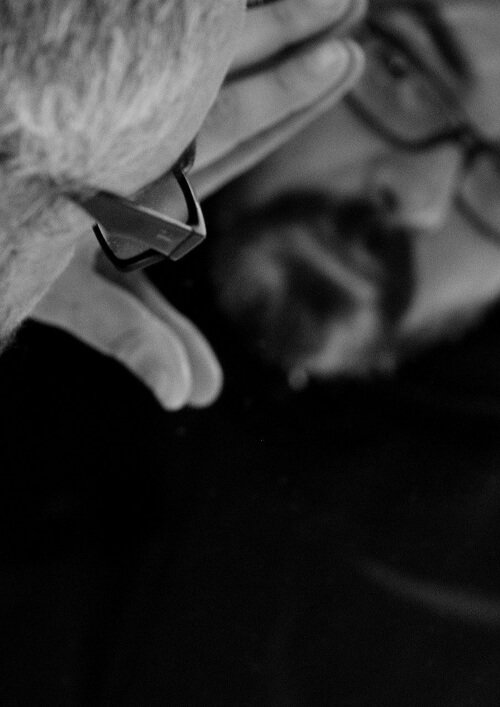
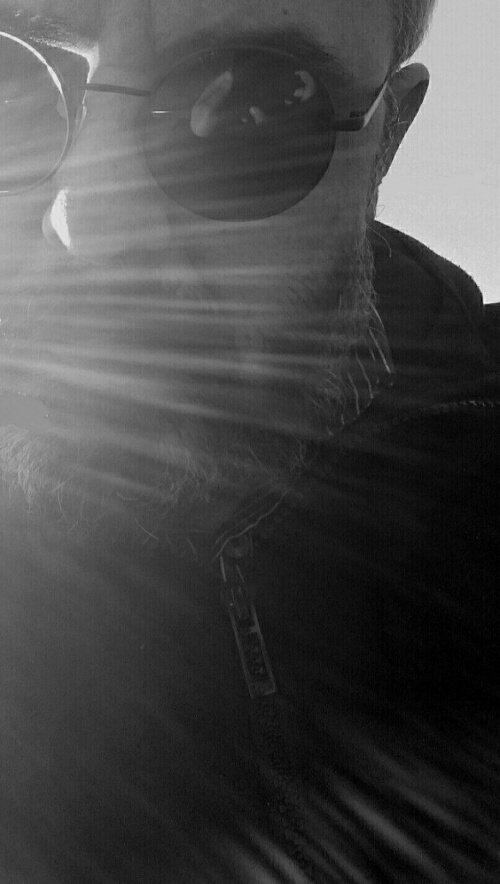
Daniel Agra Sánchez (Terrassa, Barcelona, 1969) is a Spanish self-taught artist and photographer whose practice inhabits the threshold between photography, abstraction, and visual poetry. His work begins with the visible world, yet its purpose is never to describe it. Reality becomes a point of departure, a raw and mutable substance from which he constructs images in which landscape, memory, matter, and perception are transfigured through subjective, experimental, and conceptual processes.
Within his practice, photography relinquishes its conventional role as a record of the world and becomes an instrument of interpretation, inquiry, and knowledge. The camera is no longer merely a device for bearing witness to what exists before the eye; it becomes a means of transforming reality into experience. His images therefore do not simply depict—they open: spaces in which perception, memory, and imagination can converge, overlap, and unfold.
This expanded understanding of photography forms one of the essential foundations of his visual language. Texture, framing, perceptual displacement, the progressive dissolution of recognisable forms, and a sustained investigation into photographic matter extend the traditional boundaries of the image. Photography becomes a field of transition, a place where abstraction and visual experience cease to be separate territories and converge as a single mode of perception.
His work does not seek to impose a definitive reading upon what is represented. Rather, it creates the conditions for a perceptual encounter—one capable of awakening associations that belong uniquely to each viewer. The image becomes a territory of evocation, approaching what cannot be fully contained by representation: inner states, memory, temporality, identity, and the elusive sense of belonging.
Underlying his entire trajectory is a persistent question: how can an external reality be transformed into an interior experience? This inquiry traverses his different bodies of work, taking new forms with each process of investigation—from the abstraction of landscape and the instability of perception to experimentation with matter, the object, and the very boundaries of the photographic image.
His visual language is equally informed by decades of professional experience in the worlds of fashion and raw materials, an experience that has cultivated an acute sensitivity to surface, texture, structure, and material presence. These qualities have become intrinsic to a practice that deliberately preserves the image’s ambiguity, resisting closure and allowing each work to remain porous—to sustain multiple readings, associations, and possibilities of meaning.
With more than 50 international awards and Honourable Mentions, Daniel Agra’s work has gained significant international visibility and entered the collections of museums, foundations, and institutions across Spain, the United States, Greece, South Korea, Italy, and other countries. His practice has also been featured in specialised media and international publications devoted to photography and contemporary art.
Yet recognition is not the measure by which his work should ultimately be understood. What matters is the space it opens within contemporary discourse on image, territory, and subjectivity: an approach to abstraction not as an escape from reality, but as a deeper passage into it—a way of looking beyond what the eye can recognise in order to approach what experience can only intuit.


Quotes
During the creative process, which aims to find a personal voice, thoughts and ideas emerge that lead me to conclusions which corroborate the visual approach. These fragments, presented here in the form of texts, narratives, or aphorisms, complement and reinforce that transcendence and personal meaning.
“Everything we see is the perspective of a subjective exegesis.”
“Our essence and our biology, from the microscopic to the vast magnitude of the stars, are interconnected with creativity and emotions. We are a portion, a fractal, a sprout of the universe and of creation. We are pure energy, that is why the role of the artist is to pose questions, not to answer them, because it is not about what we see it’s about what we help others see.”
“To know by heart. Nobody becomes better simply by knowingand permanently memorising data, because the real goal is to teach how to thinkto encourage doubt, to inspire questions. Answers are not the truth, they seeka truth that will always be relative. Creative and curious people always havenew questions that, on the other hand, have been repeated since thedays of the greek philosophers: when, where, what, who, and why. Let us usememory only to recall the questions we asked as children… ¿what’s behind themirror?… that is the source that springs from the oasis of knowledge.”
“Creativity is an act of boldness and rebelliousness a creator of new language, a motivation and a path toward new questions, it pushes us toward greater revelations in wisdom and philosophy, connecting us with emotions, a disobedience to the established order and orthodox opinion on the road to progress.”
“Photography does not have a fixed language and its meanings constantly change depending on each individual’s perspective. Viewing a photograph the same way can create a connection; viewing it differently reveals a new dimension and meaning. Factors such as personal experience, mood, cultural, historical and social context, create different messages that offer answers to questions never before posed, illuminating the hidden and creating paths that lead to a deeper understanding, since the narrative and photographic and visual dialogue is never a defined or definitive norm. From this perspective, and in a globalized world where the photographic image has ceased to be a primary tangible objective of representation, description, and documentation, it becomes a measure of identity and self-esteem, making it imperative to re-evaluate its purpose, potential, and capacity to impact the human mind and decision-making.”
“Art is not about reflecting beauty or about something intellectual that must be explained to a lucky “initiated”, art is about revealing, through introspection, the essence of reality a poetic and tangible manifesto that follows an unconventional and emotional path, emerging from the unexpected corners of existence.”
“We live in a society that educates us to fear being different, to fear thinking differently, something we must avoid in order to belong, with the only argument being the strength of the collective, rewarding imitation, silent obedience, and mimicry. Without questioning, we only contribute to the creation of a sick society. To mimic in order to belong and fit in is to erase freedom it is to renounce oneself. Difference is the valuable force that makes us authentic, creative, and real, helping to create a healthy, strong, and vital society.”
“Abstraction is the first step in activating imagination and intuition, extracting essence in its most emotionally pure form, without dogma an anarchic, rebellious, sensitive, and unconventional replica, through our eyes, we make visible a reality of the world that we cannot describe in any other way.”
“Naturalness is a calm rebellion without certainties that generates an unmatched magnetism which dazzles. People who dare to be normal and authentic without poses, filters, or masks are not trapped in an archaic rigidity of fixed and inflexible ideas, they accept and encourage change, constantly reinventing themselves in tune with life’s evolutionary movements, they are not only open to learning, but also show their methodology, understanding, and reasoning through questioning thereby avoiding the constant dogmatic indoctrination that only leads to stagnation, they become a unique universe unto themselves.”
“From its very beginnings, photography has been a multidisciplinary and multicultural art form that connects the author’s dialogue with a vision of personal visual and narrative elements. Just as there are countless cultures and languages, there are countless photographic languages and visual cultures. To disregard and ignore sensitivity with the sole aim of shaping obedient, purely rational minds devoid of empathy and questioning is to stigmatize, erase, and atrophy emotional understanding preventing the development of free and independent souls who understand, cultivate, and preserve the diversity of other languages and visual cultures without needing to share their identity.”
“Essence and beauty hold the virtuosity of abstract forms, a fluid and allegorical subtlety created by light, allowing us to see and express that which is sometimes unexplainable through conventional photographic language, this unleashes creativity, exploration, and progress a refuge of intelligence and the generating principle for the flourishing of individuals, society, and the world all aligned and bound to a conformist visual and intellectual tradition.”
“The artistic quality is the path through which experimental and visionary practice flows, the seed of new sensitive forms and languages that emerge from imagination, it unveils hidden truths and complex themes that invoke and embody creative freedom through diverse perspectives, questioning and standing in opposition to so called contemporary photography, an amalgam of images and narratives, all equally saturated, carrying the same slogans, arguments, and discourses rendered empty by their synonymous and dogmatic manner of expression.”